Physical Presence for Citizenship: How Many Days You Need and How to Count Them
How much physical presence do you need for U.S. citizenship? Learn the 913 and 548-day rules, how USCIS counts your days, and how trips abroad reduce your total.
Of all the U.S. citizenship requirements, physical presence is the one that comes down to simple arithmetic: were you inside the United States for enough days? Yet it trips up more applicants than almost any other rule, because the days are easy to miscount and easy to confuse with continuous residence. This guide explains exactly how much physical presence you need, how USCIS counts your days, and how travel abroad reduces your total.
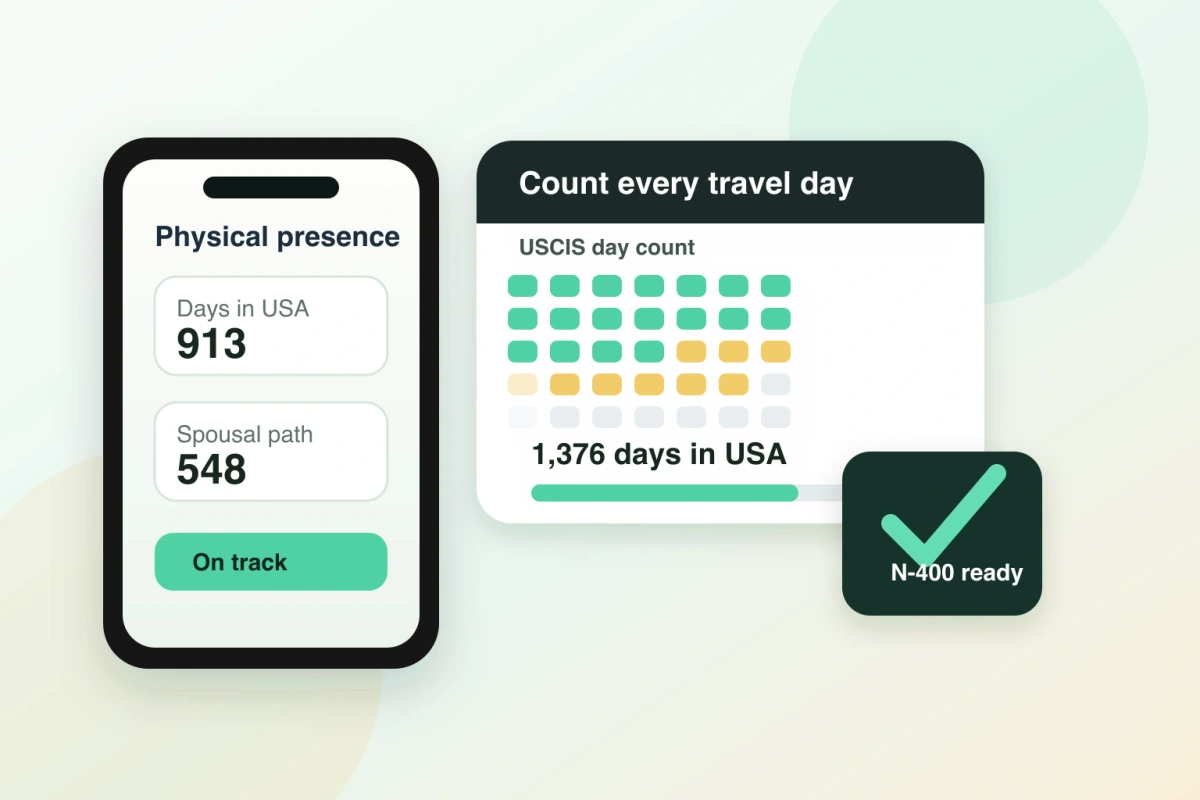
Quick Answer: To naturalize, you must be physically present in the United States for at least half of your statutory period: about 913 days (30 months) for the 5-year path, or about 548 days (18 months) for the 3-year path if you are married to a U.S. citizen. USCIS counts both your departure and return days as presence; only full days abroad are subtracted. Physical presence is separate from continuous residence, and you must meet both.
What Is the Physical Presence Requirement for U.S. Citizenship?
Physical presence is the total number of days you were physically inside the United States during your statutory period. To qualify for naturalization, you must have been present for at least half of that period. It is one of the core eligibility requirements, alongside continuous residence, good moral character, and the English and civics tests.
The rule exists to make sure applicants have genuinely lived in the country, not just held a green card from afar. Because it is a pure day count, it is also the requirement you have the most control over: every trip you take, and every day of that trip, changes the math. The official standard is set out in the USCIS Policy Manual, Volume 12, Part D{:target=“_blank”}.
How Many Days of Physical Presence Do You Need?
The number depends on which path to citizenship you are on:
| Path | Statutory period | Physical presence required |
|---|---|---|
| Standard (5-year) | 5 years | at least 913 days (about 30 months) |
| Married to a U.S. citizen (3-year) | 3 years | at least 548 days (about 18 months) |
In plain terms, you need to have spent at least half of the qualifying years inside the United States. For the 5-year path, that leaves a maximum of roughly 912 days you can be abroad across the entire period before you fall short. Certain military applicants follow different rules, and some qualifying overseas employment can be preserved with Form N-470, but for most green card holders the 913 and 548-day figures are what matter.
It also helps to know when the count is measured. USCIS looks at your physical presence over the statutory period immediately before you file, and it confirms that you still meet the requirement at the time of your interview and decision. That means presence is not checked only once at filing; you should remain mindful of long trips while your application is pending, because additional time abroad before your interview can still affect your case.
How Does USCIS Count Physical Presence?
This is where people lose or gain days without realizing it. USCIS counts physical presence day by day, and the counting rule is specific:
- The day you leave the United States counts as a day of presence.
- The day you return to the United States also counts as a day of presence.
- Only the full days you spend entirely outside the country are subtracted from your total.
So a two-week trip abroad does not cost you 14 days of presence; it costs you the days fully outside the country, because your departure and return days still count. For example, if you fly out on June 1 and return on June 15, both June 1 and June 15 count as days of presence, and only the 13 full days in between are subtracted. This works gently in your favor, but it is not a loophole, and it does not reduce how carefully you need to track your travel.
Days before you became a lawful permanent resident do not count. Only your time as a green card holder during the statutory period is included. Time spent on a temporary visa, as a student, or as a visitor before you received your green card does not add to your physical presence for naturalization.
What Counts as a Day of Physical Presence
A few situations cause confusion, so it helps to be clear about what counts:
- Any day you are physically inside the United States counts, including weekends, holidays, and days you were sick or not working.
- Travel days count. As noted above, both your departure day and your return day are treated as days of presence.
- Time in U.S. territories such as Puerto Rico, Guam, and the U.S. Virgin Islands generally counts as presence in the United States.
- Time abroad does not count, even if you were there for work, family care, or reasons outside your control. Intent does not change the day count, although it can matter separately for continuous residence.
When in doubt, the rule is simple: if you were standing on U.S. soil that day, it counts; if you were not, it does not.
Physical Presence vs. Continuous Residence
These two requirements are easy to confuse, but they measure different things, and you must satisfy both. Physical presence is the total days you were in the country. Continuous residence is about not breaking the continuity of living here with a long single trip.
Use the three-tier continuous-residence rule as a separate screen:
- Under 6 months: usually the lower-risk zone for continuous residence, though every full day abroad still reduces physical presence.
- 6 to 12 months: can create a rebuttable presumption that you interrupted continuous residence, so you may need evidence of U.S. ties.
- 12 months or more: automatically breaks continuous residence for naturalization unless an approved Form N-470 preserves it. If that happens, the common recovery anchor is 4 years + 1 day from the return date for the 5-year path.
A single trip of 6 to 12 months can create a continuous residence problem even when your total physical presence is comfortably above the minimum. In the other direction, a series of shorter trips can leave you short on physical presence while your continuous residence stays intact. For a full breakdown of how the two interact, see our guide on continuous residence versus physical presence.
How Trips Abroad Reduce Your Physical Presence
Every full day outside the United States subtracts from your running total, and those days accumulate across the whole statutory period regardless of how many separate trips they come from.
Consider a green card holder on the 5-year path who takes one long trip each year: a 5-week visit home, a 3-week vacation, and a few shorter trips, adding up to about 100 days abroad per year. Over 5 years that is roughly 500 days outside the country, leaving about 1,325 days of presence, well above the 913-day minimum. But someone who spends 4 to 5 months abroad every year can quietly cross the line and fall short, even without any single trip long enough to threaten continuous residence. The danger is that the days add up invisibly when you are not tracking them.
A Worked Example
Maria became a permanent resident on March 1, 2021, and plans to file for citizenship on the 5-year path. Over five years she takes the following trips abroad: 45 days in 2021 to care for a parent, 20 days in 2022 for a wedding, 30 days in 2023 on vacation, a longer 120-day trip in 2024 for a family matter, and 25 days in 2025. Her total time abroad is 240 days. Her statutory period is roughly 1,826 days, so her physical presence is about 1,586 days, comfortably above the 913-day minimum.
Now imagine Maria’s trips had each been longer, averaging 200 days abroad per year. Across five years that is about 1,000 days outside the country, which would leave her with roughly 826 days of presence, short of the 913 required. She would have to wait and accumulate more days before filing, even if no single trip ever broke her continuous residence. The lesson: track the running total, not just individual trips.
Common Physical Presence Mistakes
- Relying on memory. Most people underestimate their total time abroad. USCIS checks your answers against Customs and Border Protection records, so guessing is risky.
- Forgetting short trips. Weekend trips to Canada or Mexico and quick work trips are easy to omit, but they still count against your total.
- Confusing it with continuous residence. Meeting one does not mean you meet the other.
- Filing too early. The 90-day early filing rule lets you apply before your anniversary, but it does not lower the days you need. You must still reach the full total.
How to Calculate and Track Your Physical Presence
Because physical presence is a running total that changes with every trip, the safest approach is to count it continuously rather than scramble before you file. You can get a quick estimate with our citizenship eligibility calculator, which works out your days from your green card date and trips abroad.
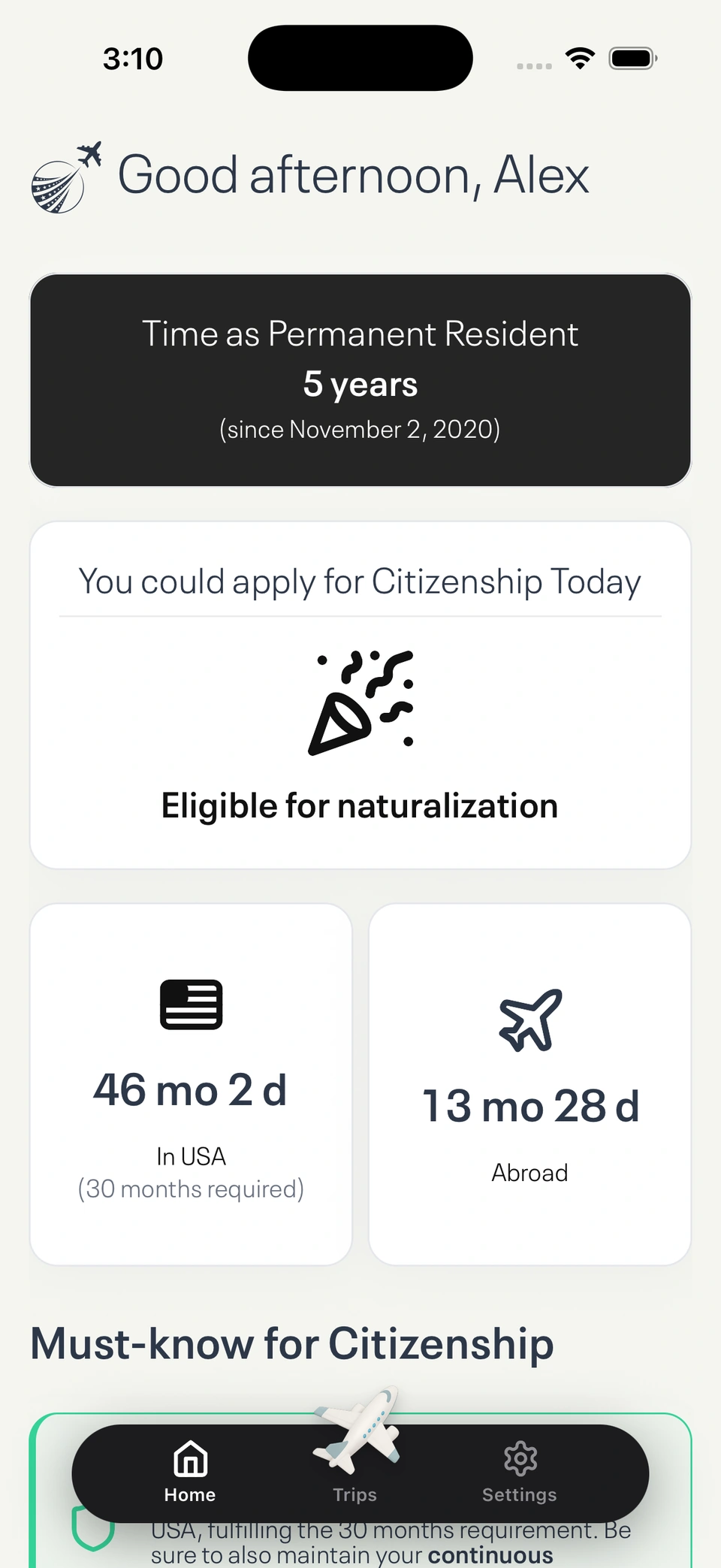
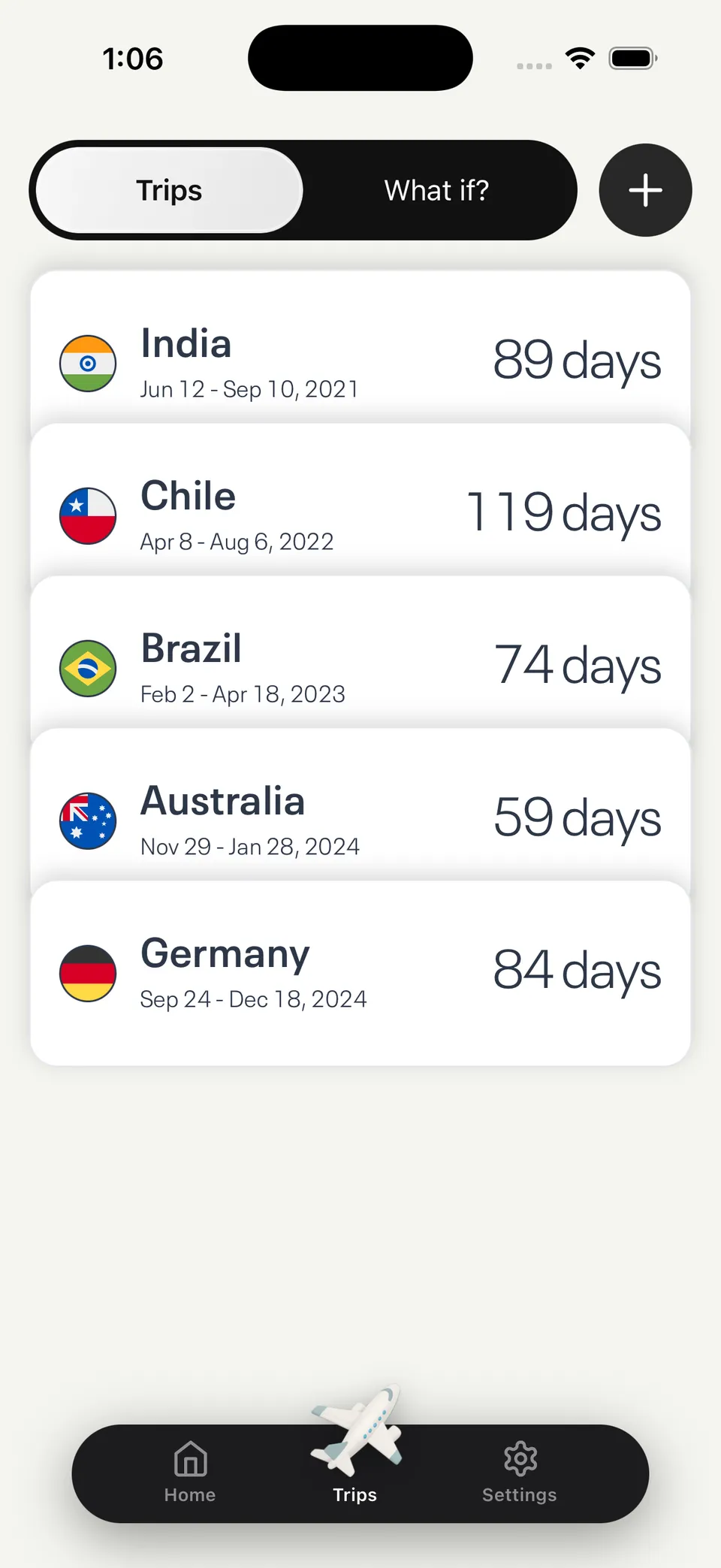
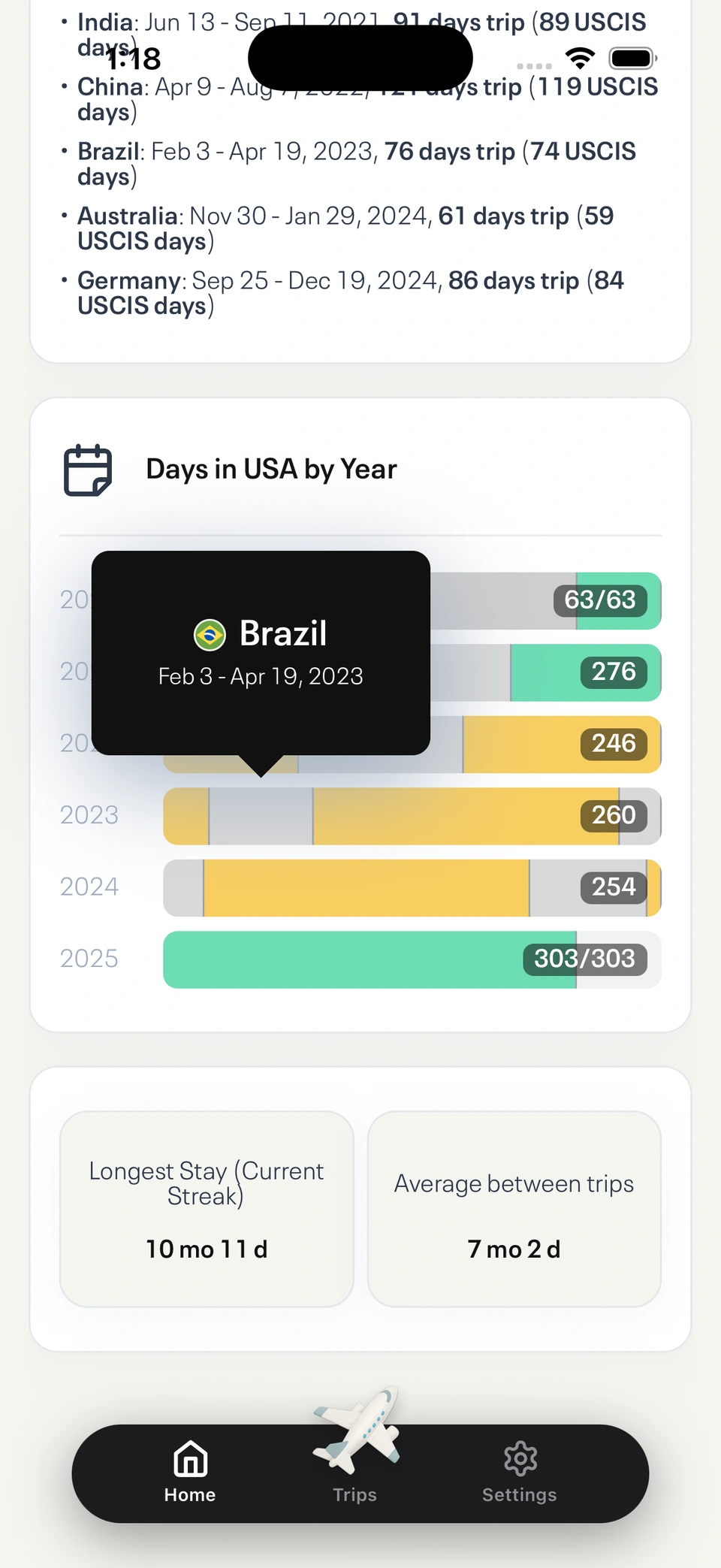
For ongoing accuracy, the Green Card Trips app lets you log trips manually and calculates physical presence from those entries as your travel changes, so your total stays current and your Form N-400 travel history is accurate. Download it from the App Store or Google Play. To see how the timeline fits together, read when you can apply for citizenship, and keep your days counted so nothing surprises you at your interview.
Frequently Asked Questions
How many days of physical presence do I need for U.S. citizenship?
You generally need to be physically present in the United States for at least half of your statutory period: about 913 days (30 months) for the 5-year path, or about 548 days (18 months) for the 3-year path if you are married to and living with a U.S. citizen. These are minimums, and you must also meet the separate continuous residence requirement.
Do the days I leave and return count as physical presence?
Yes. USCIS counts both the day you depart the United States and the day you return as days of physical presence. Only the full days you spend entirely outside the country are subtracted from your total. This rule works slightly in your favor, but it does not change the need to track every trip accurately.
What is the difference between physical presence and continuous residence?
Physical presence is the running total of days you were actually inside the United States. Continuous residence is about not breaking the continuity of living here with a single long trip. You must satisfy both. A single trip of 6 to 12 months can create a continuous residence problem even if your total physical presence is still fine, and many short trips can fail physical presence even if continuous residence is intact.
Does physical presence reset if I break continuous residence?
Effectively, yes. If a long trip breaks your continuous residence, your clock generally restarts from your return date, and you begin accumulating both continuous residence and physical presence again from that point. So a break does not just pause your timeline; it usually means counting your physical presence days over a new statutory period.
Can many short trips cause me to fail the physical presence requirement?
Yes. No single short trip breaks continuous residence, but every day abroad still subtracts from physical presence. Several trips of a few weeks each can add up to more than the time you are allowed outside the country. For the 5-year path you can spend at most about 912 days abroad across the period before falling short of the 913-day minimum.
How do I calculate my physical presence?
Add up every day you were inside the United States during your statutory period, counting both travel days, then compare that total to the requirement (913 days for the 5-year path or 548 for the 3-year path). Doing this by hand is error-prone, so most applicants use a tool. Our citizenship eligibility calculator estimates it from your green card date and trips, and the app keeps the count current as you travel.
Does the 90-day early filing rule change my physical presence requirement?
No. The 90-day early filing rule lets you submit Form N-400 up to 90 days before your residence anniversary, but it does not reduce the physical presence days you need. You must still accumulate the full 913 or 548 days, and USCIS confirms your presence at the time of decision, not just at filing.
Do I need to be in the U.S. continuously, or just for enough total days?
For physical presence, only the total number of days matters, not whether they are consecutive. However, continuous residence is a separate requirement that does care about long single absences. So you can travel and still meet physical presence as long as your total days inside the country reach the minimum and no single trip breaks continuous residence.
Does time before I became a permanent resident count toward physical presence?
No. Physical presence for naturalization is counted only during your statutory period as a lawful permanent resident: the 5 years (or 3 years) immediately before you file Form N-400. Time spent in the United States on a visa or before you received your green card does not count toward this requirement.
What happens if I am short on physical presence days when I apply?
If you file before you have accumulated enough days, USCIS can deny your Form N-400, and you would lose the filing fee and need to reapply. This is why confirming your total before filing matters. Track your trips, calculate your days, and make sure you have met both physical presence and continuous residence before you submit.
Disclaimer: This article provides general information and is not legal advice. Eligibility determinations are made by USCIS based on your individual case. Consult a licensed immigration attorney for your specific situation. Updated June 2026.